Festivals and Thai Culture
Festivals and Thai Culture
Vesak, Songkran, the rains retreat and the Kathina robe offering, and how Thai Buddhist festivals are kept in Australia.
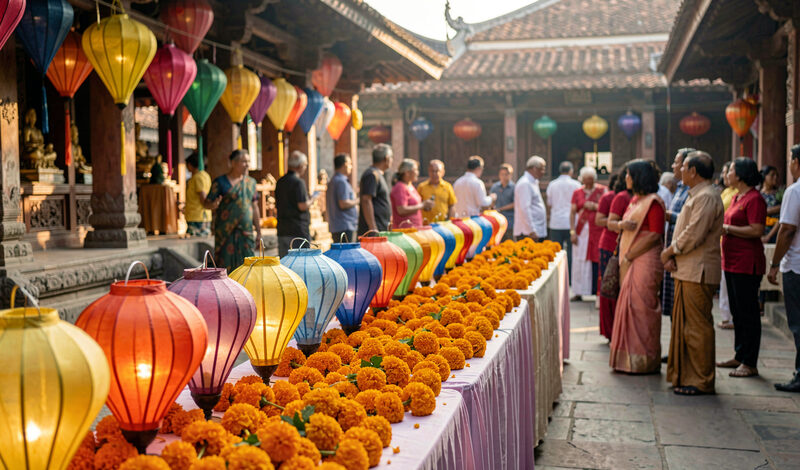
The Buddhist year in Australia is marked less by dates on a public calendar than by weekends when a temple car park fills, food stalls go up along a fence line and saffron robes move between a shrine hall and a marquee. For Thai, Lao, Cambodian, Burmese and Sri Lankan communities in Queensland, the festival calendar is where religion, food, language and family meet in the open. This section of The Paperbark Journal explains the main days of that calendar and what a visitor will see on each one.
What this section covers
Three festivals carry most of the year. Vesak, or Visakha Puja, falls on the May full moon and commemorates the Buddha's birth, enlightenment and passing in a single day; it is the most solemn of the three, marked by candles, chanting and the offering of precepts.
Songkran, the Thai New Year in April, is the most visible: water is poured over Buddha images and over the hands of elders as a blessing, sand stupas are built in temple grounds, and the day doubles as the community's biggest open day of the year.
The Kathina robe offering closes the three-month rains retreat in October or November, when lay supporters present new cloth to monks who have kept the retreat in one place. It is less known outside the community and one of the oldest fundraising ceremonies in the Buddhist world.
What a visitor should know
Every festival is open to the public at most temples, and Australians who are not Buddhist attend regularly: for the food, for the music, or because a partner's family is involved. The etiquette is the same as on an ordinary visit, covered in the temple visiting guide: shoes off in buildings, modest dress, no touching of monks by women, and care with cameras during ceremonies.
Food stalls at Thai festivals are usually run by volunteers raising money for temple buildings or monk support. Prices are low, cash is normal, and queues at popular stalls are part of the day.
The days between the festivals
Between the named festivals sit the observance days: the four phases of the moon on which devout lay people take eight precepts and spend the day or the night at the temple. They pass almost invisibly to outsiders, but they are the calendar's connective tissue, the reason a wat is never quite empty on a quiet Tuesday. The full moon and new moon days carry the most weight, and the October full moon is the one that ends the rains retreat and opens the Kathina season described in the Kathina guide.
What the calendar teaches
Read as a whole, the festival year teaches the tradition's own emphases. Vesak honours what happened; Songkran honours the community that keeps it; Kathina honours the exchange that sustains it. A visitor who attends all three across a single year has seen, in effect, the entire structure of the tradition: its history, its people and its economy, each given a day and a ritual of its own.
Festivals and the wider tradition
The festivals make most sense once the basics are in place. Vesak's rituals echo the accounts in the Theravada overview, the offerings on every festival day are the public face of dana, and the rains retreat that Kathina ends is the same period during which many Australian retreat centres run their most intensive courses.
- Vesak Day in Australia
What Vesak, or Visakha Puja, commemorates, how temples across Australia mark it, and what a first-time visitor will see.
- Songkran: Thai New Year in Australia
How Songkran, the Thai New Year in April, is kept at temples in Australia: water blessings, food stalls, sand stupas and family day.
- The Kathina Robe Offering
What the Kathina ceremony is, why lay people offer cloth to monks after the rains, and how the day unfolds at Australian temples.