Temples and Visiting
Temples and Visiting
How visiting a Theravada temple works in Queensland: etiquette, alms, dress, behaviour and the communities behind each wat.
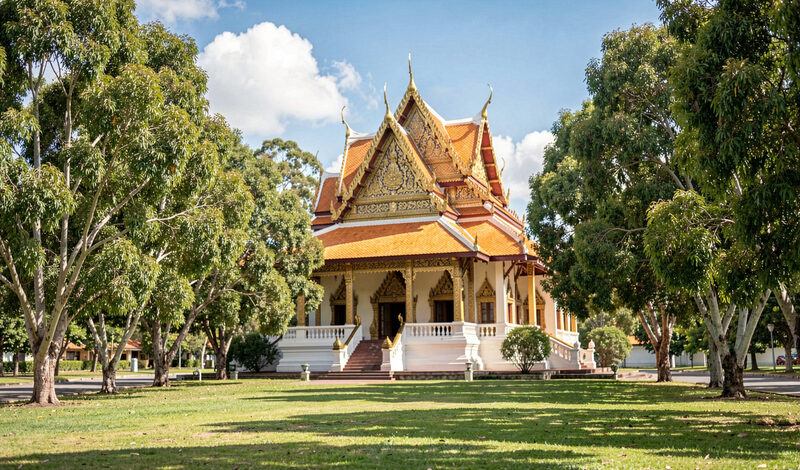
Queensland has had Theravada Buddhist temples since the early 1980s, and today they sit in places a visitor might not expect: behind a shopping strip in Ellen Grove, on acreage in Forestdale, in forest country on the ranges. Most are open every day, most welcome visitors who are not Buddhist, and nearly all are run by a mix of resident monks and lay committees drawn from the Thai, Lao, Cambodian, Burmese and Sri Lankan communities. This section of The Paperbark Journal explains how visiting works and who is who.
What this section covers
Two guides do the main work. The map of Queensland temples traces how the tradition was established: the Queensland Sangha Trust in 1981, the first vihara at Highgate Hill in 1982, the Lao temple at Bellbird Park in 1990, the first Thai temple at Ellen Grove in 1991 and its move to Forestdale, and the dozen Theravada temples counted across South East Queensland in recent years.
The etiquette guide answers the questions people ask before a first visit: what to wear, where to leave shoes, how to greet a monk, whether women may approach the shrine, what to do with a camera and how to make a donation without awkwardness.
What a temple actually is
A Theravada temple is not exactly a church and not exactly a monastery, but something of both. The resident monks keep a discipline that predates most European institutions; the buildings and grounds are maintained by lay supporters; and the weekly rhythm belongs to the lay community, which comes for chanting, meditation, food offering and festivals. Visitors are welcome to watch, to sit at the back of a hall, and usually to ask questions afterwards.
The monks' side of that exchange, including the rules about food and money, is explained in the dana guide. The path that leads a man to wear the robes a visitor sees is covered in the ordination guide.
Before the visit
Two practical notes complete the picture. Festival days change the atmosphere completely, and the festival section lists what happens on each one. And for readers whose interest begins with the practice itself rather than the institution, the meditation section explains what the monks are doing when they sit.
A word on expectations
Visitors sometimes arrive expecting either a museum or a classroom and find instead something closer to a village. Children run in the grounds, elders gossip over food containers, a monk repairs a gutter in the background. That ordinary texture is not a failure of the place's solemnity; it is the place working as intended. The solemn parts are real, but they live inside the ordinary ones, and the guides in this section try to show both.
Temples in this magazine's other pages
The temple is the thread that ties the whole site together. The meditation taught in the meditation section is the practice the monks model; the festivals mapped in the festival section happen on temple grounds; and the teachings section explains why the buildings, the bowls and the robes are arranged the way they are. A reader who keeps one thread through all four will find they all end at the same gate.
- Visiting a Thai Buddhist Temple
Shoes off, shoulders covered, feet pointed away: the practical etiquette for visiting a Thai Buddhist temple in Australia.
- Thai Temples in Queensland
A short map of Thai and Theravada temples in Queensland, from Forestdale to regional communities, and how each fits local life.