Festivals and Thai Culture
The Kathina Robe Offering
What the Kathina ceremony is, why lay people offer cloth to monks after the rains, and how the day unfolds at Australian temples.
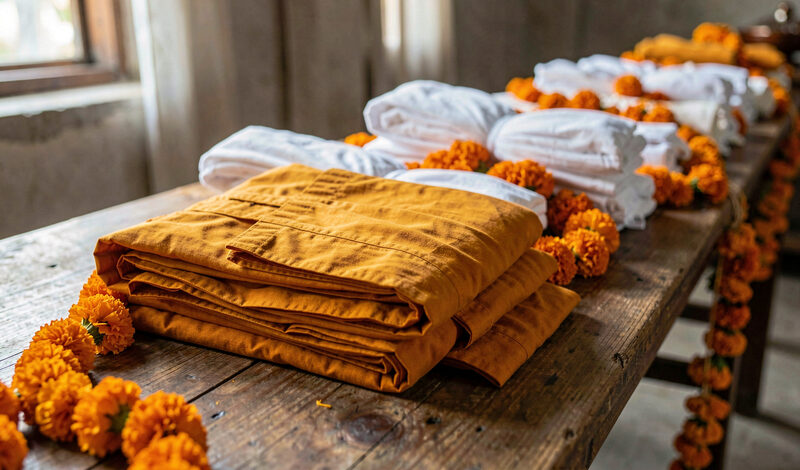
Every year, around October or November, Thai temples hold a ceremony that few outsiders have heard of and no temple can do without. Kathina is the presentation of new robe cloth to monks at the end of the three-month rains retreat: the oldest organised act of lay giving in Buddhism, still performed, still bound by rules set down in the Vinaya, and still the day when a community literally clothes its monks for the year.
The rains retreat that precedes it
To understand Kathina, begin with vassa. During the monsoon months, monks are required by the code to stay in one place rather than wander: a three-month residence running roughly from July to October, ending on the full moon of October. The retreat concentrates monastic life; it is when temporary ordinations cluster, when teaching is most intensive, and when the bond between a community and its monks is at its strongest.
Kathina is the door that closes that period. A monk who has kept the rains unbroken at a temple is eligible to receive the Kathina cloth there, and the lay community that presents it performs one of the most meritorious acts in the tradition's accounting.
What happens on the day
The ceremony is precise about its object. The offering is cloth, not a finished robe: the tradition holds that the merit of Kathina attaches to giving the material, which the monks then cut and sew into robes, often in a communal sewing session on the same day or soon after. The cloth is formally presented to the assembled monks, who nominate one among them to receive it; the formula is chanted, the cloth is spread, and the whole assembly shares the merit.
Around that core, an Australian Kathina looks like the other temple festivals: precepts in the morning, the food offering before noon, families in their best clothes, a marquee if the crowd outgrows the hall. What distinguishes it is the moment the cloth is brought forward, usually in procession, often with money trees and other offerings attached, and carried through the crowd to the shrine. It is the community's annual act of material care made visible.
The customs behind the robe and the retreat are described in Thanissaro Bhikkhu's survey of monastic customs, which remains the clearest English-language source on the form.
Where the rules come from
Kathina's details are not folk custom but codified law: the allowance for the cloth offering appears in the Vinaya itself, and the rules still bind. The cloth may only be given to a community whose monks kept the rains together; it must be presented within the month after the retreat ends; and the privilege of receiving it belongs to a monk who completed the full vassa at that temple. The original account describes monks travelling in the wet season whose robes wore out on the road, and the Buddha allowing lay people to supply new cloth at the rains' end. The modern ceremony, marquee and all, is that allowance still running.
Why Kathina matters to the community
Kathina is also, plainly, the year's main fundraising day, and the tradition has never hidden that. Temple building funds, monk support and community projects are announced and collected in the day's flow, with the money trees and sponsored cloth bundles doing the work that a church's annual appeal does elsewhere. The Buddhist Council of Queensland's materials on local temple life, accessible via the Council's site, show how these ceremonies anchor the calendar of the state's communities.
The merit attached is specific: giving Kathina cloth is ranked among the highest acts of dana precisely because it is bounded, communal and needed. The wider logic of that giving is set out in the dana guide.
Visiting a Kathina
The etiquette is the standard form described in the visiting guide, with one addition: the procession and the robe presentation are the day's solemn core, and cameras are best kept low during them. The festival sits in a calendar with Vesak and Songkran; together the three give a complete picture of the year at the temples mapped in the Queensland temples guide. And for those curious about the life the robes signify, the ordination guide explains what wearing them means.
When it falls
Kathina has no fixed calendar date: it may be held on any day within the month following the end of vassa, which lands each year in October or November. Each temple fixes its own day, usually the nearest convenient Sunday, and the communities coordinate loosely so that supporters can attend more than one. A visitor who wants to catch the ceremony should check a temple's own announcements from late September onward, when the date for that year is posted.