Teachings and Ideas
Dana: Offering Food to Monks
How alms and dana work in Theravada communities: what to offer, how to offer it, and the morning food round in Australia.
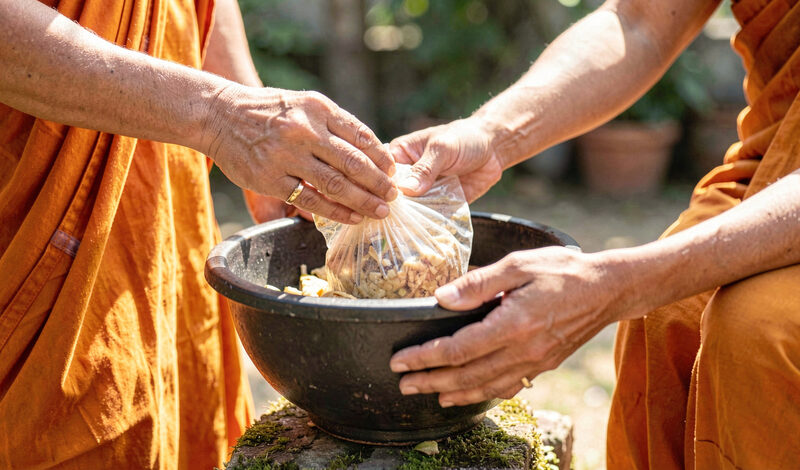
At most Theravada temples in Australia, the most important hour of the week is not a sermon or a class but a meal. Lay people arrive carrying dishes; monks sit in a row behind their bowls; food is offered, a blessing is chanted, and the monks eat what they have been given. The practice is called dana, generosity, and it is the load-bearing custom of the whole tradition: the daily exchange on which the monastic order has depended for twenty-five centuries.
Why giving comes first
In the traditional order of practice, dana precedes virtue, and virtue precedes meditation. The sequence is deliberate. Generosity loosens the grip of wanting; virtue keeps the loosened mind out of trouble; meditation then has somewhere to stand. The Buddha's recorded teachings on giving, gathered in resources such as the Wheel publication on dana at Access to Insight, treat it as the opening move of the path rather than a fundraising mechanism, though it is also, undeniably, how the monks eat.
The exchange is structured so that both sides give. Lay people give food, robes, medicine and shelter; monastics give teachings, blessings, an example and a field of merit. Neither side pays the other, which is precisely what keeps the relationship from becoming commercial.
What monks may and may not do
The monastic code shapes everything a visitor sees at offering time. Monks may not buy food, cook for themselves, or store food overnight; they eat what is offered each day, traditionally before noon. Under the strict Vinaya they may not handle money at all, which is why temples appoint lay stewards to receive cash donations. When a monk declines money pressed into his hand, it is the rule working, not a refusal of kindness.
The morning alms round, in which monks walk silently through a neighbourhood with their bowls, survives in modified form in Australia: some temples keep a short round through their grounds or a nearby street, and the same ritual is recreated at the food line inside the hall. Either way, the meaning is the same: the monk receives, the giver gives, and the bowl is the meeting point.
How a visitor can take part
Nothing about joining in is complicated, but a few conventions make it graceful. Food is offered with both hands, ideally standing a little lower than the seated monk. Women do not touch monks or hand things to them directly; offerings pass via the bowl, a cloth or a lay attendant. Prepared dishes are welcome, cooked that morning, and meat is accepted: monks eat what is given, which is why a temple meal mirrors the kitchens of its community.
For anyone who would rather watch first, a Sunday at a Thai temple is the easiest entry in the country. The etiquette guide covers dress and behaviour, and the Queensland temples guide shows where the communities are.
Dana beyond the food line
The same principle extends to robes, building funds, medicine and the festival offerings that fill the calendar. The annual presentation of new cloth after the rains retreat, described in the Kathina guide, is the oldest form of it: a named ceremony in which the whole community supplies the order's material needs for the year ahead. At festivals such as Songkran and Vesak, the food stalls and donation tables are not sideshows to the religion; they are the religion, doing what it has always done.
Dana and the temple's economy
The custom also explains the finances a visitor sees. Temples do not charge admission, monks do not draw salaries, and programs are rarely priced. What looks like generosity made free is actually a complete economy: the buildings, the electricity bills and the monks' bowls are all carried by voluntary giving, organised through lay committees and stewards. Visitors who want to contribute will find donation boxes near the shrine hall and stewards happy to explain what a project is raising. The rule for a guest is simple: giving is welcome, never expected, and always routed through the lay side.
The blessing that follows the meal
After the monks have eaten, most temples close the meal with a chant of blessing directed back at the givers. Visitors are welcome to stay for it. The words are in Pali and the form is ancient: the order returns, in the only currency it holds, a share of the merit of the meal. Whatever a guest makes of the idea, the moment reads clearly enough: the exchange closes in both directions, and the community leaves the hall having given to the monks and been given to in return.
What dana teaches the giver
Practitioners describe the effect plainly: something given freely returns as a lighter hold on everything else. The tradition asks only that the giving be voluntary, unpublicised and without expectation, which is a harder standard than it sounds. In the wider frame of Theravada practice, dana is where doctrine becomes a habit of the hand before it ever becomes a state of the mind.