Teachings and Ideas
What Is Theravada Buddhism
Theravada Buddhism explained: its Pali canon roots, its path through Sri Lanka and South East Asia, and its place in Australia.
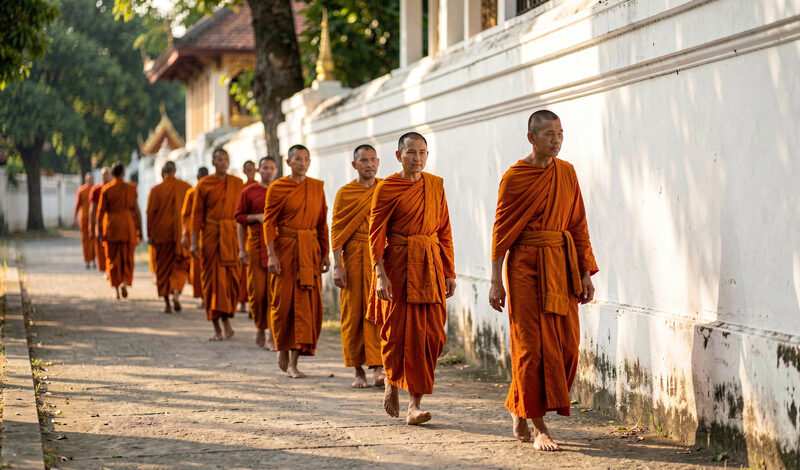
Theravada is the oldest continuously surviving school of Buddhism, the dominant tradition of Sri Lanka, Thailand, Myanmar, Laos and Cambodia, and the tradition behind most of the temples with tiered roofs that Australians now pass in suburbs from Brisbane to Perth. Understanding what it is, and what it is not, makes sense of nearly everything else this magazine covers.
The name and the claim
The word Theravada means the doctrine, or school, of the elders. The tradition sees itself as the conservative heir of the earliest Buddhist communities: it holds to the Pali canon, the collection of texts preserved in the Pali language and committed to writing in Sri Lanka in the first century BCE. Other schools added later scriptures; Theravada's claim is to have kept the oldest layer intact. Historians would qualify that claim in places, but the canon itself is genuinely early and unusually complete.
The texts are organised in three baskets: the discourses of the Buddha, the monastic code, and the analytical works known as the Abhidhamma. The full collection is freely readable today at SuttaCentral, which hosts modern translations side by side with the Pali.
What Theravada teaches
The framework begins with the four noble truths: that ordinary experience is marked by unsatisfactoriness, that this arises from craving, that it can end, and that there is a path to its ending. The path has eight factors, usually grouped as conduct, meditation and wisdom. Nibbana is the name for the ending itself, and the arahant is the one who has reached it.
Two things follow that distinguish the tradition in practice. First, the monastic order matters enormously: monks keep a code of 227 rules, and the ideal life in the texts is the ordained one. Second, the lay life has its own serious frame: generosity, virtue and support of the order, which is why customs like offering food to monks are not peripheral but structural.
How it spread through Asia
Buddhism reached Sri Lanka, by the tradition's own account, in the third century BCE under the emperor Ashoka's missions, and from there the Theravada line moved through South East Asia over the following millennium. Thailand became its most populous home, and the Thai forest tradition of the nineteenth and twentieth centuries, associated with teachers such as Ajahn Mun and his student Ajahn Chah, revived an emphasis on direct meditation practice that now defines much of Theravada's image in the West.
Theravada and the other schools
Australia holds all the major Buddhist traditions at once, and visitors sometimes confuse them. Theravada is the school of the Pali canon, the saffron or ochre robes, and the single-minded ideal of the arahant. Mahayana, the tradition of China, Japan, Korea and Vietnam, works from later Sanskrit-derived texts and holds the bodhisattva ideal of liberating all beings. Vajrayana, the Tibetan tradition, adds ritual and tantric methods. In Brisbane the difference is visible in a single afternoon: the Thai wat at Forestdale and the large Chinese temple at Chung Tian are both called temples, but they belong to different worlds.
How it reached Australia
Theravada came to Australia twice. It arrived first as an interest of English-speaking converts in the mid twentieth century, and then, decisively, as the religion of migrants from Sri Lanka, Thailand, Laos, Cambodia and Myanmar after the 1970s. Queensland's temples grew directly from that second wave: the Queensland Sangha Trust formed in 1981, and community temples followed through the 1980s and 1990s, as traced in the guide to Queensland temples.
The result today is a two-strand tradition: heritage temples that serve diaspora communities in their own languages, and meditation-centred groups that serve a largely English-speaking public. Many places, the Forestdale temple among them, are both at once.
A tradition that asks to be tested
One more thing distinguishes Theravada's tone, and it matters for how this magazine writes about it. The discourses repeatedly present the teaching as something to be tested in experience rather than accepted on authority: the famous instruction to the Kalamas tells them not to accept a claim because of tradition, scripture or hearsay, but because they have tried it and found it true. That posture, unusual among religions, is part of why meditation-centred Theravada found such a receptive public in Australia, and it is the posture these guides adopt: describe, cite, and let the reader try.
Where to go from here
The teaching that touches daily life most directly is the five precepts, and the practice most readers try first is breath meditation. For a first look at a living temple rather than a text, the visiting etiquette guide covers everything a guest needs.