Festivals and Thai Culture
Songkran: Thai New Year in Australia
How Songkran, the Thai New Year in April, is kept at temples in Australia: water blessings, food stalls, sand stupas and family day.
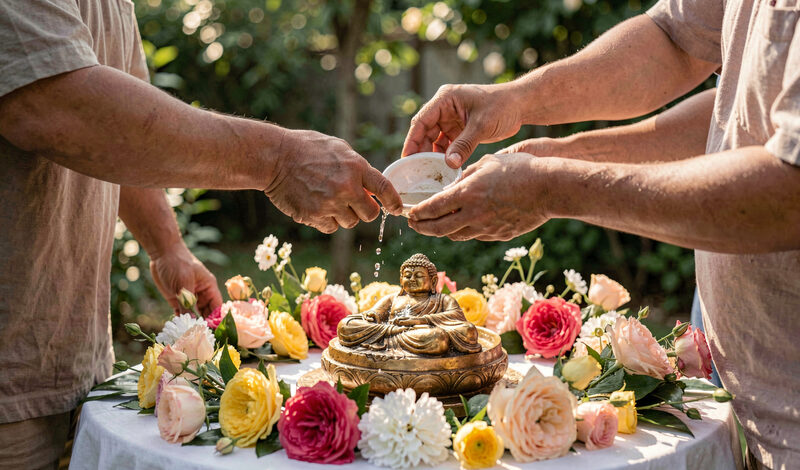
Songkran is the Thai New Year, three days in mid-April that begin with the most famous water festival in the world and end, at least at Australian temples, as the friendliest open day of the calendar. If Vesak is the year's solemn pole, Songkran is its joyous one: the same religion, wearing its other face. For Australians it is also the easiest Buddhist festival to attend, because the whole point of the day is that everyone is welcome and everyone gets wet.
What Songkran is
The word comes from a Sanskrit term for the sun's passage into a new position; the festival marks the traditional New Year across mainland South East Asia, kept by Lao, Cambodian and Burmese communities as well as Thai. In Thailand it runs 13 to 15 April and has grown into a country-wide water fight. At temples in Australia the water survives in its original form: not a weapon but a blessing.
The core acts of Songkran are washing and honouring. Buddha images are bathed with scented water; the same water is poured gently over the palms of monks and elders as a sign of respect and a wish for the year. The day's other distinctive custom is the sand stupa: families bring or build small mounds of sand in the temple grounds, decorated with flags, symbolically returning to the temple the soil carried away on shoes through the year.
What happens at an Australian temple
A Queensland Songkran is a community fair wrapped around a ceremony. The morning keeps the religious form: precepts, chanting, the bathing of the Buddha image, offerings of food to the monks in the pattern described in the dana guide. By late morning the grounds fill with food stalls, and the day becomes what it largely is: a showcase of a community's cooking, music and dancing, open to anyone who walks in.
The water blessing continues through the day, usually at a table where visitors are welcome to pour. A few temples keep a supervised water-splashing area; most keep the playful side mild compared with Bangkok. What is consistent everywhere is that the festival is the community's front door: the day most non-Thai Australians first see inside a temple, and the day the community works hardest to make them glad they came.
Who else keeps the day
Songkran is a Thai name for a shared festival. Lao communities keep Pi Mai, Cambodian communities keep Chaul Chnam Thmey, and both fall on the same April days with the same grammar of water, elders and merit. At temples serving those communities in Queensland the customs run nearly parallel, and visitors from one tradition are generally welcome at another's celebration. The Buddhist Council of Queensland lists the state's member communities, and the Council's website is the most reliable single directory for finding which temple keeps which day.
The meaning under the water
Beneath the celebration Songkran carries the ordinary Theravada machinery: merit-making, the support of the order, the renewing of family and community bonds. The new year is a natural point for it. Gifts to monks on Songkran rank among the most meritorious of the year, which is why the offering tables are full; the same exchange that runs every Sunday runs at festival scale. The structure of that exchange, and the reason giving is placed first in the tradition's order of training, is explained in the Theravada overview and the dana guide.
Practical notes for a first visit
Songkran is the one festival where normal temple etiquette meets water. Dress stays modest: shoulders and knees covered even in the heat, with the full checklist in the etiquette guide. Shoes come off inside the shrine hall. Women do not touch monks, which on this day extends to the water blessing: pour for the image and for elders, and let lay attendants handle anything that passes hand to hand. A change of clothes or a towel is sensible at temples that keep a splashing area.
Cash is useful for the food stalls, which are priced low and run by volunteers. The stalls are fundraising in the same tradition as the offerings inside: buying lunch is a small act of dana with lunch included.
The rest of the festival year
Songkran sits between the year's two other poles: the solemnity of Vesak in May and the closing ceremony of the rains retreat, Kathina, in October or November. Where each is kept is mapped in the Queensland temples guide, whose communities are the ones who make these days happen.